Guides
Law firm website design in 2026: what to include, what the rules allow, and where to start
A law firm website design checklist: the pages clients look for, what bar rules say about testimonials, results and contact forms, accessibility and speed, and when a template beats an agency.
Most articles about law firm website design are lists of good-looking sites. They tell you to show awards, add testimonials and put results on the home page. What they rarely mention is that a law firm website is lawyer advertising, and the rules for lawyer advertising decide what you can say about results, testimonials and specialization, and even what your contact form should warn people about.
This guide is for lawyers who are planning a new site and for the designers who build it. It covers the pages a law firm website needs, what the advertising rules say about each of them, accessibility and speed, and when a lawyer website template is enough and when an agency is worth it.
A word on honesty first: we sell a law firm website template, LawFirm, and we use it as the example at the end. We are not lawyers, and this article is not legal advice.
Current as of November 16, 2026. Not legal advice. Lawyer advertising rules differ from state to state and change: New York rewrote its main advertising rule on June 1, 2026.[6] Check the current rules in your jurisdiction, or ask your state bar or your own counsel, before you publish.
In short
- A law firm website answers four questions: who you are, what matters you handle, who will work on the client’s case, and how to get in touch (our assessment). The pages follow from that: home, practice areas, attorney profiles, results, insights, contact and legal pages.
- The site is lawyer advertising. Under the ABA Model Rules, it must not be false or misleading, results can mislead without context, “specialist” needs a named certifying organization, and the site must name a lawyer or firm responsible for its content.[1, 2, 3]
- States differ. New York dropped its mandatory “Attorney Advertising” label and results disclaimer in June 2026,[6] while Florida keeps strict conditions for testimonials and results.[7]
- The contact form has legal weight. Inviting people to describe their matter without clear warnings can make them prospective clients, with confidentiality duties attached.[5]
- Accessibility and speed are part of the design. The ADA lists a lawyer’s office as a public accommodation, and the Justice Department points businesses to WCAG for their websites.[8, 9]
- Template or agency: a template is enough when your structure is standard and you can write the content yourself; an agency makes sense for custom features and ongoing marketing (our assessment). Neither one makes your content compliant for you.
What pages does a law firm website need?
Someone looking for a lawyer usually has a specific problem and little time. The site’s structure should let them check fast whether you handle their kind of matter, who would work on it, and how to reach you (our assessment). Here is the page set we would start with, and the rule to keep in mind on each page.
| Page | What it should answer | Watch out for |
|---|---|---|
| Home | Who you are, what you handle, where you practice, how to get in touch | Name and contact details of a lawyer or firm responsible for the site[2] |
| Practice areas | One page per area: the kind of matters, who handles them, typical first steps | “Specialist” only with a certification you can name;[2] Florida bars advertising areas you don’t currently practice[7] |
| Attorney profiles | Bar admissions, education, experience, the matters each lawyer works on | Comparisons with other lawyers must be substantiated[1] |
| Results and case studies | What the matter was, what you did, what happened | Results without context can create unjustified expectations[1] |
| Testimonials and reviews | What it was like to work with you | Some states set strict conditions, Florida among them[7] |
| Insights or blog | General information on the questions clients ask | General legal information does not by itself make readers prospective clients[5] |
| Contact | How to reach the right person, what happens next | Warnings before people describe their matter[5] |
| Legal pages | Privacy policy, terms, cookies, disclaimers | Have your own counsel adapt them (our assessment) |
The order of the home page matters too. We would put the practice areas and the way to get in touch on the first screen, then the people, then proof such as results and reviews (our assessment).
What do the advertising rules say about your website?
This section summarizes the rules we checked; it is not legal advice. The ABA Model Rules are a template that each state adopts and changes in its own way, so the rule that binds you is your state’s version.
The baseline: ABA Model Rules 7.1–7.3
- No false or misleading statements. Rule 7.1 forbids false or misleading communications about a lawyer’s services, including true statements that omit a fact needed to keep the whole message from being misleading.[1]
- Results need context. The comment to Rule 7.1 explains that a truthful report of past results can mislead if it suggests the same outcome is likely for others regardless of the facts of their case. Unsubstantiated comparisons with other firms can mislead too. A suitable disclaimer or qualifying language may prevent that.[1]
- Specialization. Under Rule 7.2(c), a lawyer may not state or imply certification as a specialist unless the certifying organization is approved or ABA-accredited and is named in the communication.[2]
- Who is responsible. Rule 7.2(d) requires every such communication to include the name and contact information of at least one lawyer or law firm responsible for its content.[2]
- No paying for recommendations. Rule 7.2(b) bars giving anything of value for recommending a lawyer’s services, with narrow exceptions such as advertising costs and nominal thank-you gifts.[2] Keep that in mind before rewarding clients for reviews (our assessment).
- A website is not solicitation. The comment to Rule 7.3 says a communication directed to the general public, such as a website, is not a solicitation.[3]
States differ: New York and Florida
New York amended its advertising rules effective June 1, 2026, essentially adopting the ABA versions of Rules 7.1 and 7.3. The requirement to label advertisements “Attorney Advertising” and the mandatory “Prior results do not guarantee a similar outcome” statement were both eliminated, although the New York State Bar Association notes that lawyers may still want to use such a disclaimer.[6] Many older guides still tell New York firms to add both, so check the date of any advice you follow (our assessment).
Florida keeps detailed rules. According to the Florida Bar’s advertising handbook (approved December 10, 2025):[7]
- Testimonials are allowed only if the person is qualified to evaluate the lawyer, describes their own experience, and the experience is representative of what clients generally get. The lawyer may not write the testimonial, the person may receive nothing of value for it, and a testimonial that mentions results needs a clear and conspicuous disclaimer that others may not get the same results.
- Past results must be factually verifiable and must not omit facts that would make them misleading.
- Characterizations and comparisons of lawyers’ skills, experience or record must be objectively verifiable.
- Practice areas you don’t currently practice may not be advertised.
- Websites don’t have to be filed for review, but you may file a specific page for review.
Those two states pull in different directions, which is the point: before you publish results, reviews or a “specialist” label, read your own state’s current rule (our assessment).
The contact form is not just a design element
Under ABA Model Rule 1.18, a lawyer owes duties to a prospective client even when no engagement follows: the lawyer may not use or reveal what the person shared, and may be disqualified from representing the other side.[4] The comment to that rule explains that a consultation is likely to have occurred if a lawyer’s advertising invites people to submit information about a possible representation without clear warnings that limit the lawyer’s obligations, and someone does.[5]
What we would do on the contact page (our assessment; agree the wording with your counsel):
- Put a short, plain warning above the form: sending the form does not create a lawyer-client relationship, and visitors should not send confidential details until you have confirmed you can take the matter.
- Ask only for what you need for a first reply and a conflict check: name, contact details, the other parties, the type of matter.
- Route the form to a mailbox that is monitored and protected, not to a shared inbox.
Accessibility and speed
Accessibility. Title III of the Americans with Disabilities Act lists the office of a lawyer among public accommodations.[8] The Justice Department’s guidance says Title III covers businesses open to the public, gives them flexibility in how they make their websites accessible, and names the Web Content Accessibility Guidelines (WCAG) and the Section 508 Standards as helpful technical guidance.[9] The current version, WCAG 2.2, is a W3C Recommendation built on four principles: content must be perceivable, operable, understandable and robust.[10]
In practice (our assessment): check contrast, visible focus and keyboard navigation through the whole contact form; give the video a text alternative or make sure the page works without it; write descriptive link text; and test with a screen reader. Automated tools find only part of the problems, so a high accessibility score is a start, not a certificate. We cover what to check in a template in our checklist for choosing a website template.
Speed. Google’s Core Web Vitals consider a page good when the largest content appears within 2.5 seconds (LCP), the page responds to input within 200 milliseconds (INP), and the layout shifts no more than 0.1 (CLS), measured at the 75th percentile of visits on mobile and desktop.[11] For a law firm site the usual culprits are a heavy hero video, large photos of the team and third-party chat widgets (our assessment).
Law firm website template or an agency?
When we searched on November 16, 2026, agency blogs filled most of the first page for “law firm website design”, and website builders and theme marketplaces filled most of it for “lawyer website template”. Both routes can work. The difference is in what you pay for and what stays your job (our assessment):
| Law firm website template | Agency | |
|---|---|---|
| What you get | A designed site with the standard pages, ready to fill with your content | A design and content made for your firm |
| Time to launch | As fast as you can write and approve the content | Depends on the agency’s process |
| Cost | The template price, plus hosting and your time | Project fees, often with ongoing retainers |
| Custom features (intake systems, client portals) | You or a developer add them | Usually included or quoted |
| Compliance of the content | Your responsibility | Still your responsibility: the rules bind the lawyer, not the designer |
A template is enough for most small and mid-sized firms whose structure is standard: practice areas, people, results, insights, contact. An agency is worth it when you need custom functionality, ongoing marketing, or a brand built from scratch (our assessment). If you pick a template, check it the way you would check any attorney website template: open the live preview on a phone, go through it with a keyboard, look at the speed, and read the licence.
Example: what LawFirm covers and what you still do
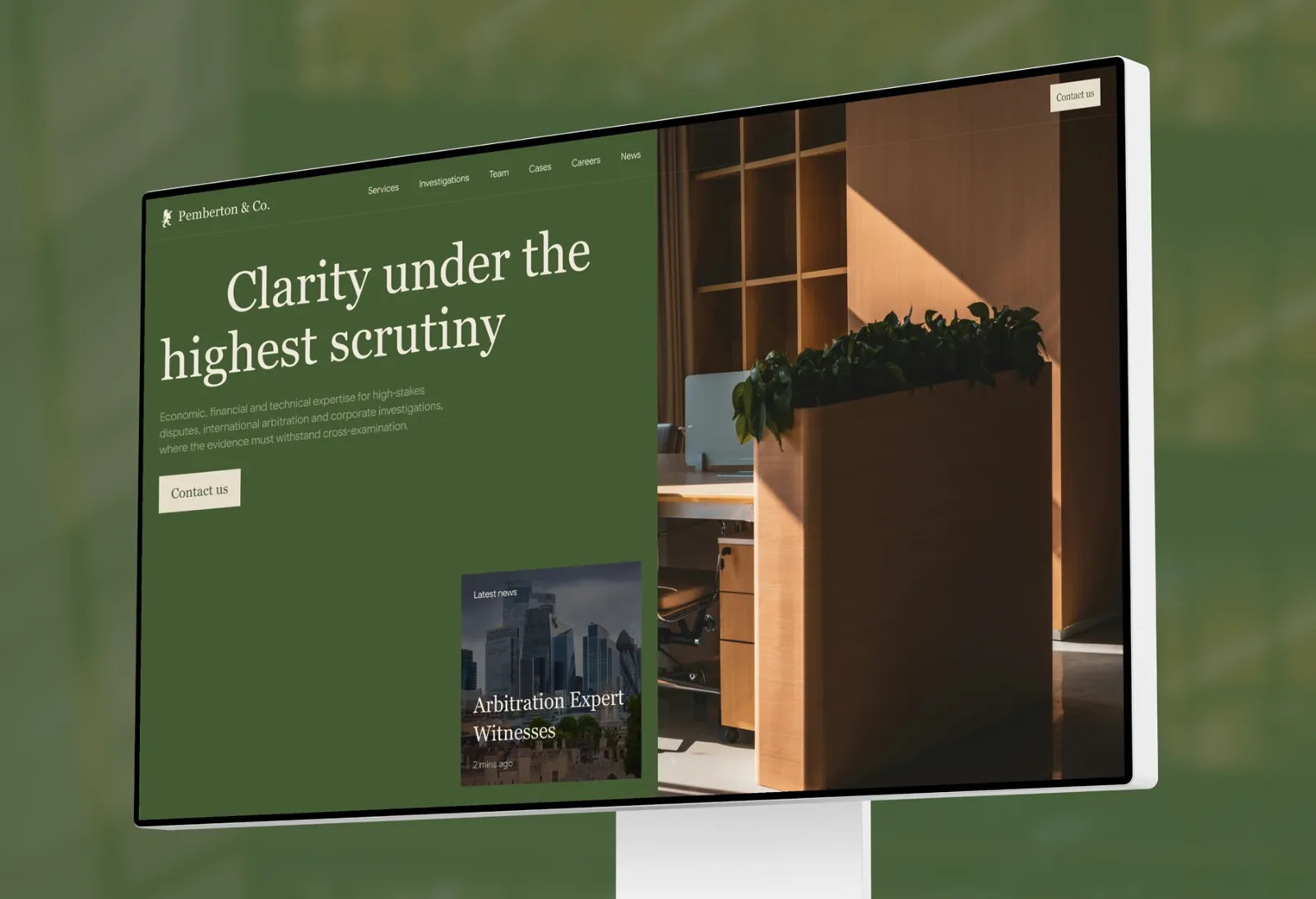
LawFirm is our law firm website template, built with Astro. Here is how it maps to the checklist above, using the facts from its template page:
- Home: a video hero, results in numbers with source links, a client testimonial and a featured practice area.
- People: a team grid filtered by practice area and 12 sample profiles, each with a role, biography, credentials, expertise and the matters the person worked on.
- Results: 12 representative matters filtered by practice area, and a case study page that tells each matter as a story: the headline numbers, then the question, the approach, the evidence and the outcome. That structure gives the context the comment to Rule 7.1 talks about.[1]
- Insights, careers and contact: news and long-form articles, open roles with an application form, and a confidential enquiry form with a matter-type picker next to the office addresses.
- Legal pages: a privacy policy, terms, cookies and a legal notice.
- Speed and accessibility, measured: desktop Lighthouse scores of 100 for performance, 96 for accessibility, 100 for best practices and 100 for SEO (November 13, 2026).
What you still do yourself:
- Fit it to your practice. The demo firm is an international disputes and arbitration practice. A local family law or personal injury firm would rewrite the copy and reorganize the practice areas (our assessment).
- Check results and the testimonial against your state’s rules before you replace the sample content.
- Add the warning to the contact form and connect the forms to the email or intake tool you use: they are designed forms and don’t send email on their own.
- Have your counsel adapt the legal pages: they are complete sample texts, not legal advice.
You can see LawFirm with your own firm name, logo and colours before you buy, or open the template page for the full list of pages and the live preview. How to adapt it with an AI assistant is in our guide to customizing an Astro template with Claude Code.
A checklist before launch
- Every practice area has its own page, and nothing you don’t currently handle is listed.
- No “specialist” or “expert” claim without a certification you can name, unless your state’s rule allows it.
- The site names a responsible lawyer or firm with contact details.
- Each result has context: the matter, what you did, the outcome; disclaimers where your state expects them.
- Testimonials and reviews meet your state’s conditions, and no one received anything of value for them.
- Comparisons and superlatives (“best”, “top”) can be backed up, or are removed.
- The contact form warns visitors before they describe their matter and goes to a protected mailbox.
- The legal pages were adapted by your counsel.
- The whole site works with a keyboard and a screen reader, with enough contrast.
- The main pages pass Core Web Vitals on mobile.
Frequently asked questions
What should a law firm website include?
At minimum: a home page, a page per practice area, attorney profiles, a way to show results or case studies with context, a contact page with a clear warning above the form, and legal pages such as a privacy policy. A blog or insights section helps people find you through search (our assessment).
Can a law firm website show client testimonials and past results?
Often yes, but the conditions depend on the state. The ABA Model Rules allow truthful information but warn that results can create unjustified expectations without context.[1] Florida, for example, allows testimonials only under specific conditions and requires past results to be verifiable.[7] Check your own state’s rule.
Does a law firm website need a disclaimer?
It depends on the state and on the content. New York no longer requires the “Attorney Advertising” label or the prior-results statement, though its bar association notes that a disclaimer may still help.[6] Florida requires a disclaimer on testimonials that mention results.[7] Separately, a warning above the contact form helps avoid creating prospective-client duties by accident.[5]
Does the ADA apply to law firm websites?
The ADA lists a lawyer’s office as a public accommodation,[8] and the Justice Department’s position is that Title III applies to what businesses open to the public offer on the web, with WCAG as helpful guidance.[9] How that applies to your firm is a legal question for your counsel.
Is a template enough for a law firm website?
For most firms with a standard structure, yes: the work is in the content, not the layout (our assessment). You can start from a law firm website template and add custom features later. If you need a client portal, complex intake or ongoing marketing from day one, an agency may be the better choice.
Sources
Pages checked on November 16, 2026.
- American Bar Association, Model Rule 7.1: Communications Concerning a Lawyer’s Services and its Comment
- American Bar Association, Model Rule 7.2: Communications Concerning a Lawyer’s Services: Specific Rules
- American Bar Association, Comment on Model Rule 7.3: Solicitation of Clients
- American Bar Association, Model Rule 1.18: Duties to Prospective Client
- American Bar Association, Comment on Model Rule 1.18
- New York State Bar Association, Marjorie E. Gross, “The Amendments to the Advertising Rules” (amendments effective June 1, 2026)
- The Florida Bar, Handbook on Lawyer Advertising and Solicitation (approved December 10, 2025): Rules 4-7.13(b)(2), (b)(3), (b)(4), (b)(9) and 4-7.19(d), 4-7.20(g)
- Cornell Law School, Legal Information Institute, 42 U.S. Code § 12181, Definitions (paragraph (7)(F))
- U.S. Department of Justice, Guidance on Web Accessibility and the ADA (March 18, 2022)
- W3C, Web Content Accessibility Guidelines (WCAG) 2.2 (W3C Recommendation, December 12, 2024)
- web.dev, Web Vitals (updated October 31, 2024)